
June 27, 2019 NHTSA CAMPAIGN NUMBER: 19V500000
Driver Frontal Air Bag Inflator May Explode
An inflator explosion may result in sharp metal fragments striking the driver or other occupants resulting in serious injury or death.
NHTSA Campaign Number: 19V500
Manufacturer Honda (American Honda Motor Co.)
Components AIR BAGS
Potential Number of Units Affected 1,567
Summary
Honda (American Honda Motor Co.) is recalling certain 2013 Acura ILX, 2015 RDX, 2005-2010 and 2012 RL, 2009-2014 TL, 2010 and 2012 ZDX, 2007-2011 CR-V, 2011-2013 and 2015 CR-Z, 2009-2013 Fit, 2013 Fit EV, 2010-2011 and 2013 Insight and 2007-2014 Ridgeline vehicles.
These vehicles are equipped with driver frontal air bag inflators assembled as a recall remedy part or replacement service part, that may explode due to propellant degradation occurring after long-term exposure to high absolute humidity, temperature and temperature cycling.
Remedy
Honda will notify owners, and dealers will replace the driver frontal air bag inflator, free of charge. The recall began August 12, 2019. Owners may contact Honda customer service at 1-888-234-2138. Honda’s numbers for this recall are S5B and W59.
Notes
Owners may also contact the National Highway Traffic Safety Administration Vehicle Safety Hotline at 1-888-327-4236 (TTY 1-800-424-9153), or go to www.safercar.gov.
Check if your Acura has a Recall
B19-043
June 28, 2019
Version 1
Safety Recall: Takata Driver’s Airbag Inflator
AFFECTED VEHICLES
| Year | Model | Trim | VIN Range |
| 2013 | ILX | ALL | Check the iN VIN status for eligibility. |
| 2015 | RDX | ALL | Check the iN VIN status for eligibility. |
| 2005-10,
2012 | RL | ALL | Check the iN VIN status for eligibility. |
| 2009-14 | TL | ALL | Check the iN VIN status for eligibility. |
| 2010,
2012 | ZDX | ALL | Check the iN VIN status for eligibility. |
BACKGROUND
NHTSA and its independent expert reviewed the findings of three independent investigations into the Takata airbag inflator ruptures. According to NHTSA, the combination of time, high temperature fluctuations, and humidity contribute to the degradation of the propellant in the inflators. NHTSA has concluded that this degradation can cause the propellant to burn too quickly, creating more pressure than the inflator can withstand, and, in extreme cases, causing the inflator to rupture and send shrapnel through the air bag toward vehicle occupants. NHTSA is prioritizing the recall of air bag inflators based on the risk of injury or death to vehicle occupants.
This is the final phase to this campaign and involves vehicles that previously had the driver’s frontal airbag nondesiccated inflator replaced with a similar non-desiccated inflator (like for like), or an airbag module replaced with one that contained a non-desiccated inflator. This replacement may have been done as part of a recall or other repair. For more information about these inflator recalls, go to www.safercar.gov and use keyword TAKATA.
There are several bulletins with similar years and models. Make sure to do an iN VIN status inquiry and follow the indicated service bulletin.
Do an iN VIN status inquiry and, if indicated, repair the vehicle even though the vehicle may have been repaired under a previous campaign.
NOTE
If the VIN status inquiry indicates that the vehicle is subject to any open safety recalls, including the front passenger’s airbag inflator, make sure to also complete those recall repairs before returning the vehicle to the client. If you are unable to complete any open recall, advise the client of the recall status and when the recall could be completed.
CLIENT NOTIFICATION
Owners of affected vehicles will be sent a notification of this campaign.
Do an iN VIN status inquiry to make sure the vehicle is shown as eligible.
Some vehicles affected by this campaign may be in your used vehicle inventory.
Failure to repair a vehicle subject to a recall or campaign may subject your dealership to claims or lawsuits from the client or anyone else harmed as a result of such failure. To see if a vehicle in inventory is affected by this safety recall, do a VIN status inquiry before selling it.
CORRECTIVE ACTION
Replace the driver’s airbag inflator, then return the original, undeployed inflator as directed.
PARTS INFORMATION
| Part Name | Part Number | Quantity |
| 2013 ILX Driver’s Airbag Inflator Kit | 04770-TV9-405 | 1 |
| 2015 RDX Driver’s Airbag Inflator Kit | 04770-TV9-405 | 1 |
| 2005-10, 2012 RL Driver’s Airbag Inflator Kit | 04770-SJA-405 | 1 |
| 2009-14 TL Driver’s Airbag Inflator Kit | 04770-TF0-405 | 1 |
| 2010-12 ZDX Driver’s Airbag Inflator Kit | 04770-TF0-405 | 1 |
NOTES
- The inflators appear similar, but may have different rates of inflation. Make sure you install the correct inflator (confirm the part number) for the vehicle you are working on.
- Always use new Torx bolts to install the airbags. The new Torx bolts are coated with threadlock to make sure they do not come loose.
- The inflator kit box must be used to return the old inflator to its supplier. Be careful not to damage the inflator kit box.
- If the defective, undeployed inflator is not returned, the warranty claim for that vehicle will be charged back to your dealership.
- To return the inflator, follow the instructions in PIB B15-0006, Inflator Kit Return Process.
- Parts staff can scan the part number and serial number from the outside of the box into the warranty claim by using the Controlled Part Serial No. screen and scanning the applicable information. Refer to the job aid Ordering and Managing Replacement Inflators for more information.
WARRANTY CLAIM INFORMATION
NOTES
- To avoid a warranty claim being charged back to your dealership, the defective, undeployed inflator must be returned to its supplier. Follow the shipping instructions in PIB B15-0006, Inflator Kit Return Process.
- The replacement inflator part number and serial number are printed on the label that should be attached to the RO.
- To avoid non-payment of warranty claims, the new airbag inflator part number and serial number must be included in each claim. For more information, refer to step 6 of REPAIR PROCEDURE.
- The serial number is encoded into the bar code printed on the label inside of the box and on a label attached to the outside of the box. If your dealership uses a scanner, you can scan the serial number from either place into the claim.
- The part number is encoded into a barcode attached to the outside of the box. If your dealership uses a scanner, you can scan the part number into the claim.
- If you confuse the serial number and part number when entering the claim information, your claim will automatically be rejected.
- For more information about scanning and filing airbag inflator recall claims, refer to Ordering and Managing Replacement Airbag Inflators. From the iN, select Service, Warranty, Warranty Claim, then Claims Reference Guide. Under HOT TIPS/TOPICS, select Inflator Claims at a Glance.
| Year/ Model | Operation Number | Replacement Part Number | Flat Rate Time | Defect Code | Symptom Code | Template ID | Failed Part Number |
| 2013 ILX | 7521P4 | 04770-TV9-405 | 0.6 hr | 6ZT00 | S5B00 | B19043A | 77810-TX6-A80ZA |
| 2015 RDX | 7521P4 | 04770-TV9-405 | 0.6 hr | 6ZT00 | S5B00 | B19043B | 77810-TX4-A40ZA |
| 2005-10,
2012 RL | 7521P4 | 04770-SJA-405 | 0.5 hr | 6ZT00 | S5B00 | B19043C | 77810-SJA-A82ZA |
| 2009-14 TL | 7521P4 | 04770-TF0-405 | 0.6 hr | 6ZT00 | S5B00 | B19043D | 77810-TX4-A80ZA |
| 2010, 2012
ZDX | 7521P4 | 04770-TF0-405 | 0.6 hr | 6ZT00 | S5B00 | B19043E | 77810-TX4-A80ZA |
Skill Level: Repair Technician
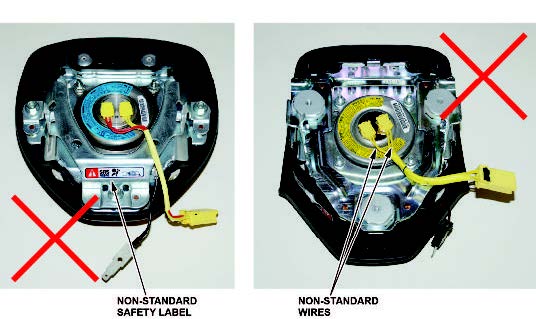
IDENTIFYING COUNTERFEIT AIRBAGS
This section goes over the steps to identify counterfeit airbags and applies to all vehicles in this service bulletin. It is referred to in each vehicle’s repair procedure. Click HERE to watch a video to help identify counterfeit airbags.
- If there is nothing unusual about the airbag or the inflator, continue with the inflator replacement procedure.
- If there are any unusual markings, like an incorrect label or a model year written in marker, the airbag and inflator may not be the correct airbag and/or inflator for the vehicle or it may be a counterfeit part. For more information about counterfeit airbags, you can refer to safercar.gov, enter keywords MANAGING COUNTERFEIT, and select Recommended Dealer Guidance for Managing Counterfeit Air Bags from the list. If you suspect that the airbag or inflator is counterfeit, do not continue this procedure. Contact your DPSM for assistance.
REPAIR PROCEDURE
NOTE:
- If the VIN status inquiry indicates that the vehicle is subject to any open safety recalls, including the front passenger’s airbag inflator, make sure to also complete those recall repairs before returning the vehicle to the client. If you are unable to complete any open recall, advise the client of the recall status and when the recall could be completed.
- Make sure you have the anti-theft code for the audio and navigation system (if applicable), then write down the frequencies for the radio’s preset buttons.
- Be careful not to damage any parts when replacing the inflator, and follow the procedure exactly.
- If, before removing the airbag, you suspect that it may be the incorrect airbag for the vehicle or a counterfeit, do not remove the airbag. Contact your DPSM for assistance.
- Make sure you have reviewed the SRS Precautions and Procedures in the service information before doing the REPAIR PROCEDURE.
- Turn the ignition switch to the ON (II) position and check if the SRS indicator comes on for about 6 seconds, then turns off.
- If the indicator comes on, then turns off after about 6 seconds, turn the ignition OFF, then go to step 2.
- If the indicator does not come on, or if it stays on, contact your DPSM for assistance.
- Disconnect the battery negative cable and wait at least 3 minutes before continuing.
- Remove the driver’s airbag module. Refer to the applicable vehicle’s service information.
- Place the airbag, face-down, on a clean shop towel.
- Visually inspect the airbag and the inflator for any unusual writing or markings. Refer to IDENTIFYING COUNTERFEIT AIRBAGS.
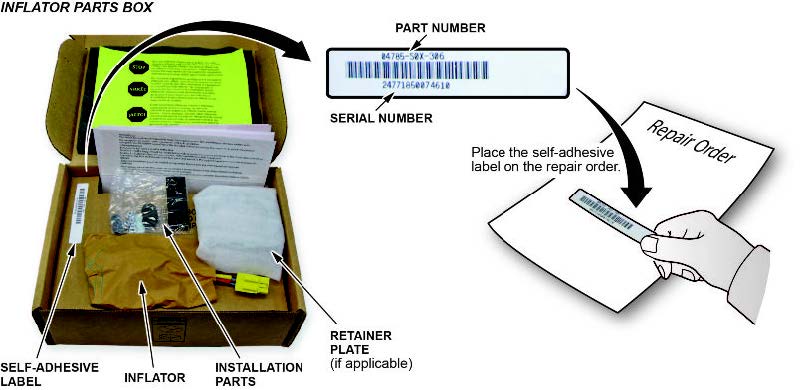
- Peel the label located inside the inflator box from its backing and attach it to the RO. For the warranty claim to be paid, the replacement inflator part number that you received must be included in the warranty claim.
NOTE:
- The replacement part number is printed on the top part of the label and the serial number is printed on the bottom. Make sure you attach the label to the RO and give it to the warranty clerk.
- There may also be a colored sticker located in the kit, ignore it because it is not used.
- Not all inflator kits have a label included. In those cases, write the serial number and part number from the side of the inflator box on the RO. The part number always starts with 047.
- If there is no horn plate installed, go to step 8. If there is a horn plate installed, follow the appropriate procedure below.
Type 2 – 2013 ILX and 2015 RDX
7.1 Evenly loosen the three bolts using a 1-inch socket.
NOTE
Do not lose any of the small rubber washers or springs for the horn plate; they are not available separately.
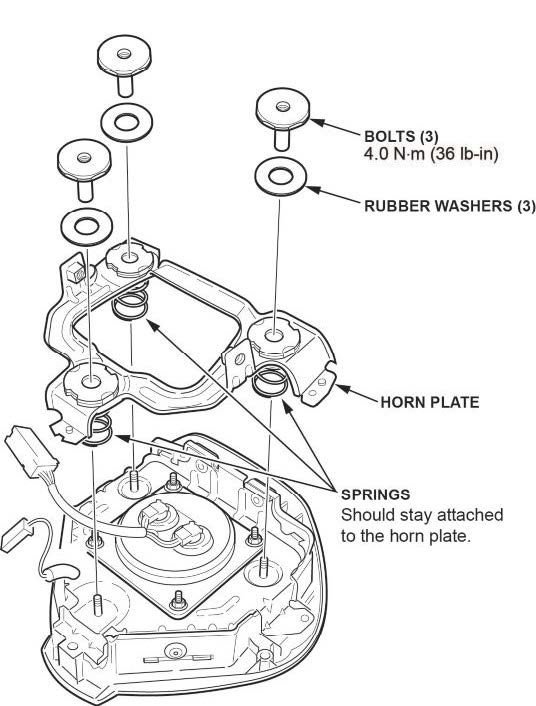
7.2 Remove the 3 bolts. Make sure you do not drop or lose the 3 black rubber washers.
7.3 Remove the horn plate. Be careful that the 3 springs stay attached to the horn plate. If the springs come loose, reinstall as needed and set aside the horn plate and components until reassembly.
Type 3 – 2009-14 TL, 2010 and 2012 ZDX
Click HERE for a video about cutting the horn plate.
NOTE
If there is no horn plate, go to step 8.
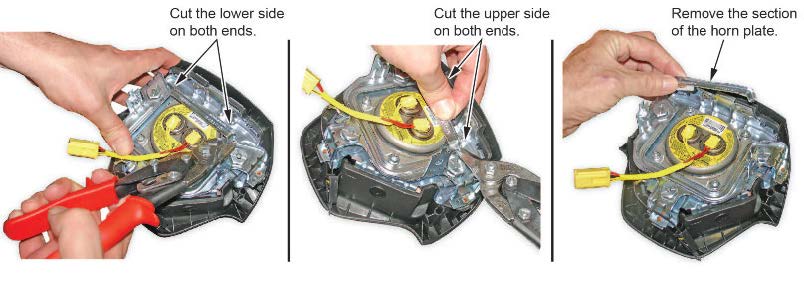
7.1 Using a marker, draw a line on the horn plate as shown.
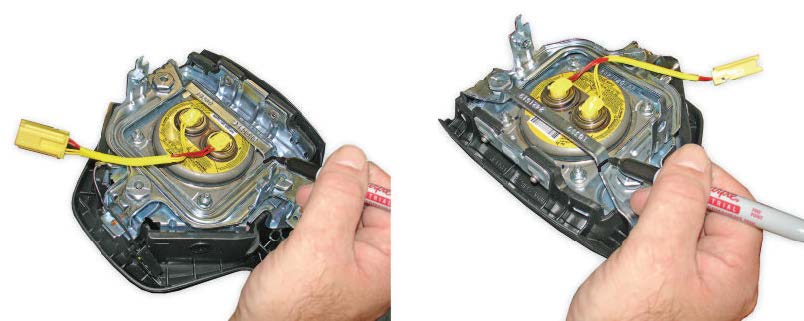
7.2 Using the snips, cut along the line drawn.
NOTE
Always use sharp snips. If they are dull and you twist or wiggle them back and forth, you may warp the horn plate, which would require a new airbag module.
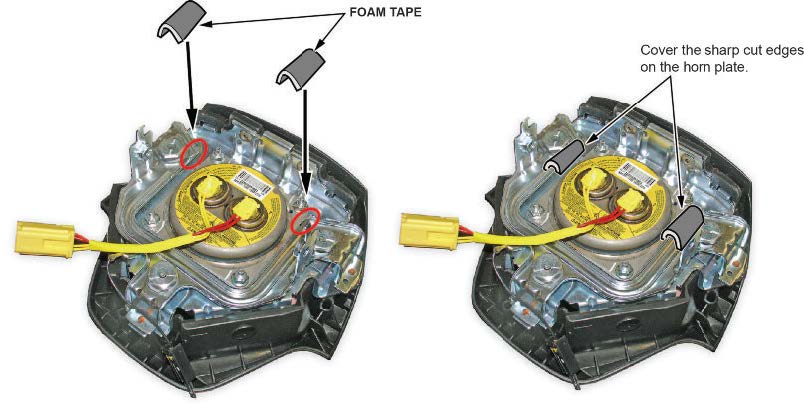
7.3 Take the felt tape and cut it into two pieces. Apply to the cut surface for protection.
NOTES
- Do not file the metal edges.
- Make sure the felt tape does not interfere with the horn plate or horn plate springs.
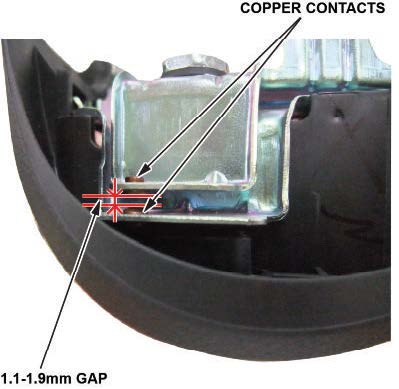
7.4 Measure the space between the two copper contacts on the horn plate as shown. The space should be between 1.1 and 1.9 mm.
NOTE
There is a copper contact on each side of the airbag module.
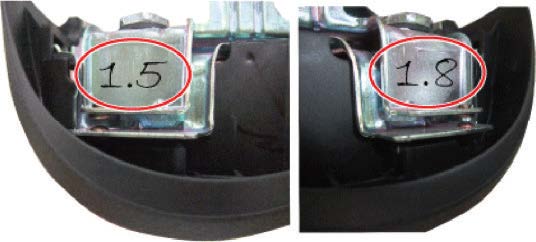
- If the spaces are within specification, write the measurements on the side of the horn plate.
- If either of the spaces is out of specification, try to correct it. If the space is too large, use a pair of pliers to close the space, or if the gap is too small, use a flat headed screwdriver to open it up so that the copper contacts are within specification. Write down the measurement on the side of the horn plate.
- Using needle-nose vise grips or a 3/8 in. 6-point socket, remove the four locknuts from the inflator. The locknuts will not be reused.
NOTE
Do not remove the inflator from the airbag until you complete step 9.
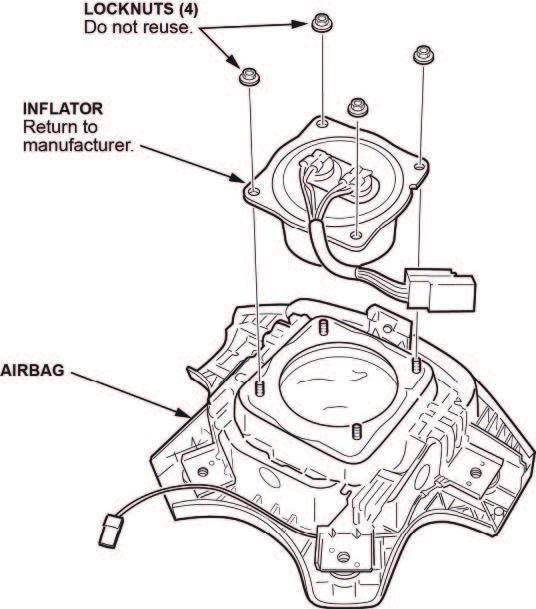
- Use shop air to clean any debris that may be on the inflator, then remove the inflator from the airbag.
NOTES
- Do not allow any debris to enter the inflator opening in the airbag.
- Do not deploy the inflator. The inflator must be returned to its supplier in the box the new inflator came in. Follow the shipping instructions outlined in PIB B15-0006 to return the undeployed inflator.
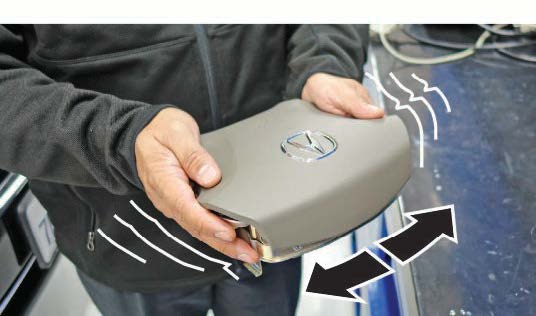
- Turn over the airbag (inflator side down), and shake it to remove any debris from the inflator opening.
- Install the new inflator in the airbag module.
NOTE
There may be some minor surface rust or corrosion on the new inflator; this is OK.
Click HERE for a short video about the different variations of the driver’s and front passenger’s replacement inflators involved with the recalls related to Takata inflators. While both the driver’s and front passenger’s inflators are shown in the video, this is informational only. Replace inflators only as directed by the iN VIN status inquiry.
There are four different styles of inflators. Make sure you use the correct installation procedures for the type of inflator you have.
| Type 1 – See 11.1 | Type 2 | Type 4 |
| 04770-TV9-405 | N/A | N/A |
| 04770-SWA-405 | ||
| 04770-TF0-405 | ||
| 04770-SJA-405 |
NOTE
Type 3 inflators are not used in Acura vehicles.
11.1 Type 1 – Check your part number against the ones listed for each installation procedure. Use the correct installation procedure for the part you received.
11.2 Place the inflator into the opening with the inflator harness toward the bottom of the airbag module.
NOTE
The image shows the horn bracket removed like on the 2013 ILX and 2015 RDX.
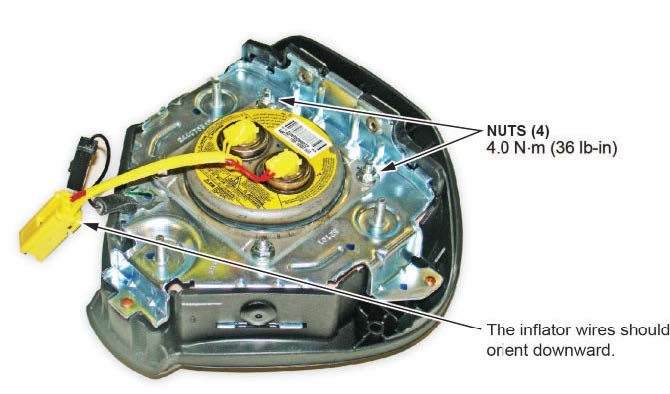
11.3 If the airbag inflator kit came with a label, attach the label to the inflator module as shown, then go to the nextstep.
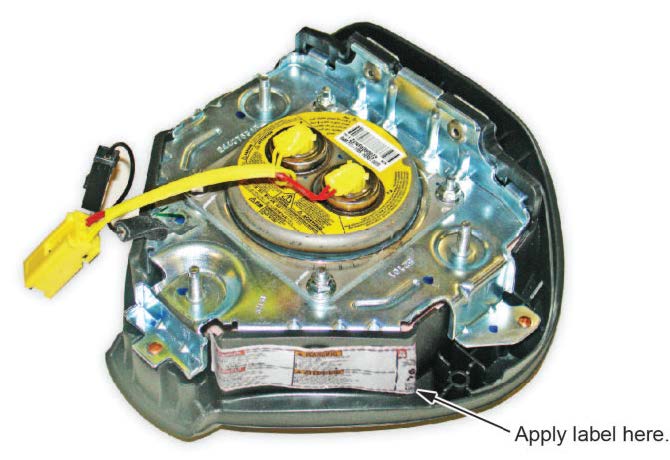
- Install and torque the new locknuts to 9 N·m (2.8 lb-ft, 34 lb-in).
- If applicable, install the horn plate.
Type 2 Horn Plate
13.1 Make sure the three springs are mounted to the back side of the horn plate as shown.
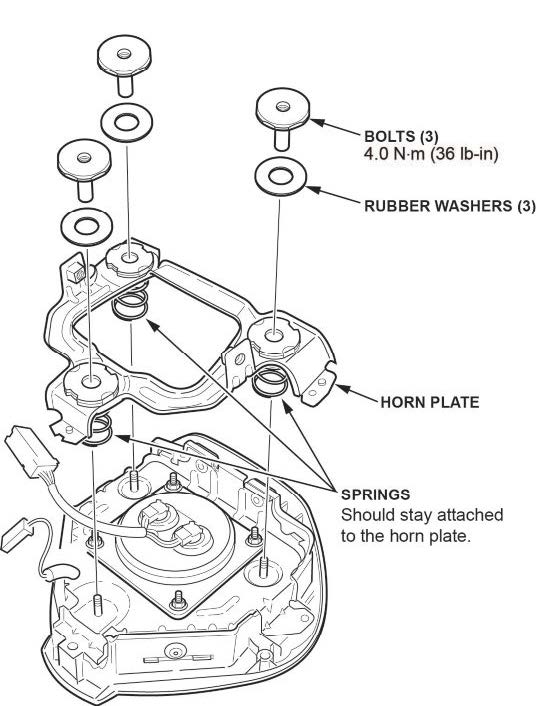
13.2 Make sure the rubber washers are installed on their respective bolts.
13.3 Install the horn plate on the airbag.
13.4 Install the 3 bolts and evenly tighten to 0 N·m (3.0 lb-ft, 36 lb-in).
NOTE
Do not over-tighten the bolts because you can break the studs and you will have to replace the airbag module.
- Reinstall the driver’s airbag using new Torx bolts from the kit and torque the bolts to 8 N·m (7.2 lb-ft). Refer to the service information.
- Reconnect the battery negative cable and do the following:
- Enter the anti-theft codes for the audio system and the navigation system (if equipped).
- Press and hold the audio unit power button to exit the anti-theft mode.
- Enter the radio presets.
- Set the clock (on vehicles without navigation).
- Start the vehicle and check that the SRS indicator comes on for about 6 seconds, then goes off.
- Give your warranty clerk the RO that includes the replacement inflator serial number and replacement part number.For the warranty claim to be paid, the replacement inflator part number must be included in the warranty claim.
END
REMEDY NOTICE
This is an important Safety Recall.
The remedy will be performed FOR FREE.
August 2019
IMPORTANT SAFETY RECALL
This notice applies to your vehicle: 99999999999999999
Dear JOHN SAMPLE,
This notice is sent to you in accordance with the National Traffic and Motor Vehicle Safety Act.
WHAT IS THE REASON FOR THIS NOTICE?
Acura has decided that a defect which relates to motor vehicle safety exists in certain 2005 – 2010 and 2012 model year RL vehicles. The driver frontal airbag inflator in your vehicle may rupture when deploying during a crash. The potential for such ruptures may occur in some of the subject airbag inflators after several years of exposure to persistent conditions of high absolute humidity. In the event of a driver frontal airbag inflator rupture, metal fragments could pass through the airbag cushion material striking vehicle occupants, potentially resulting in serious injury or death to vehicle occupants. The risk of such an occurrence increases over time. It is imperative you schedule an appointment with an authorized Acura dealer now to avoid this condition in the future.
CHECK YOUR VEHICLE FOR OPEN RECALLS
You can check your vehicle’s eligibility for repair under this or any other recall. Please access the Acura Recall Lookup tool at www.recalls.acura.com and enter your Vehicle Identification Number (VIN).
WHAT WILL ACURA DO?
Acura will replace the driver frontal airbag inflator with an inflator of a different design, free of charge. An illustration showing the location of the driver frontal airbag inflator, which is the only component of the airbag module (other components are the airbag cushion and airbag module cover) that will be replaced, during the recall repair, is shown on the right:
WHAT SHOULD YOU DO?
Please call any authorized Acura dealer and make an appointment to have your vehicle repaired for free. Once you make an appointment to repair your vehicle, be advised that the complete replacement process may take approximately 30 minutes. However, your dealer can provide you with a better estimate of the overall time for this service visit, as it may be necessary to make your vehicle available for a longer period of time. If you are not the only driver of this vehicle, please advise all other drivers and passengers of this important information!
OWNER INFORMATION
You received this notice because government regulations require that notification be sent to the last known owner of record. Our records are based primarily on state registration and title data, which indicate that you are the current owner of this vehicle. If this is not the case, or if any of the information is not correct, please complete, sign and return the Information Change Card and we will then update our records. If you are a lessor of this vehicle, federal regulations require you to forward this notice to your lessee within ten days.
DO YOU STILL HAVE MORE QUESTIONS?
If you have questions or concerns, we encourage you to:
- contact your local Acura dealer; or
- call American Honda’s Customer Support & Campaign Center at 1-888-234-2138; or
- visit Twitter @AcuraClientCare; or
- visit www.recalls.acura.com to use “Ask Us”, our 24/7 virtual agent.
If you believe that American Honda or the dealer has failed or is unable to remedy the defect in your vehicle, without charge and within a reasonable period of time (60 days from the date you first contact the dealer for a repair appointment), you may submit a complaint to the Administrator, National Highway Traffic Safety Administration (NHTSA), 1200 New Jersey Ave., SE, Washington, DC 20590. Alternatively, you may call the NHTSA toll-free Safety Hotline at 888-327-4236 (TTY 800-424-9153), or go to https://www.nhtsa.gov.
We apologize for any inconvenience this recall may cause you.
Sincerely,
American Honda Motor Co., Inc.
Campaign #S5B / Service Bulletin #19-043
AVISO DE REPARACIÓN
Esta es una campaña de seguridad importante.
La reparación se realizará de forma GRATUITA.
Campaña de seguridad NHTSA 19V-500
Agosto del 2019
CAMPAÑA DE SEGURIDAD IMPORTANTE
Esta notificación aplica a su vehículo: 99999999999999999
Estimado JOHN SAMPLE,
Esta notificación ha sido enviada a usted de acuerdo con el decreto de la oficina de Administración Nacional de Seguridad del Tráfico en las Carreteras (National Highway Traffic Safety Administration o NHTSA por sus siglas en inglés).
¿CUÁL ES EL MOTIVO DE ÉSTA NOTIFICACIÓN?
Acura ha determinado que existe un defecto el cual está relacionado con la seguridad del vehículo en algunos vehículos modelo RL año modelo 2005 – 2010 y 2012. El inflador de la bolsa de aire delantera del lado del conductor de su vehículo se podría romper al activarse durante un choque. El potencial de dichas rupturas puede ocurrir en algunos de los infladores de bolsas de aire después de varios años de exposición ante condiciones persistentes con un alto nivel de humedad absoluta. En caso de que el inflador de la bolsa de aire delantera del lado del conductor se rompa, fragmentos metálicos podrían pasar a través del material del cojín de la bolsa de aire golpeando los ocupantes del vehículo, causando posiblemente lesiones serias o la muerte a los ocupantes del vehículo. El riesgo de dicha ocurrencia aumenta con el tiempo. Es imperativo que programe ahora una cita con un concesionario Acura autorizado, para evitar esta condición en el futuro.
¿QUÉ HARÁ ACURA?
Acura reemplazará el inflador de la bolsa de aire delantera del lado del conductor con un inflador de un diseño diferente, el cual se realizará de forma gratuita. A continuación, se muestra una ilustración de la ubicación del inflador de la bolsa de aire delantera del lado del conductor, el cual es el único componente del módulo de la bolsa de aire (otros componentes son el cojín de la bolsa de aire y la cubierta del módulo de la bolsa de aire) que será reemplazado, durante la reparación de la campaña de seguridad; la ilustración se muestra en la derecha:
¿QUÉ DEBE HACER USTED?
Por favor llame a cualquier concesionario autorizado Acura y haga una cita para la reparación de su vehículo de forma gratuita. Una vez que programe una cita para reparar su vehículo, le avisamos que el proceso de reemplazo completo podría tardar aproximadamente 30 minutos. No obstante, su concesionario le puede ofrecer un mejor estimado del tiempo total de esta visita de servicio, ya que pudiera ser necesario que
su vehículo esté disponible por un periodo más largo. ¡Si usted no es el único conductor de este vehículo, por favor informe a todos los conductores y pasajeros sobre esta información importante!
VERIFIQUE SI SU VEHÍCULO TIENE UNA CAMPAÑA DE SEGURIDAD PENDIENTE
Puede verificar la elegibilidad de su vehículo para que sea reparado bajo esta campaña de seguridad o bajo cualquier otra. Por favor acceda la herramienta “Acura Recall Lookup” en www.recalls.acura.com e ingrese su número de identificación del vehículo (VIN).
INFORMACIÓN DEL PROPIETARIO
Usted recibió esta notificación porque las regulaciones gubernamentales requieren que esta notificación sea enviada al último propietario registrado. Nuestros registros están basados principalmente en los datos de título y registro en el estado, el cual indica que usted es el propietario actual de este vehículo. Si no es el caso o si la información no está correcta, por favor complete, firme y devuelva la tarjeta de Cambio de información anexa y nosotros actualizaremos nuestros registros. Si usted es el arrendador de este vehículo, las regulaciones federales requieren que usted envié una copia de esta notificación a su arrendatario en un lapso de diez días.
¿USTED TODAVÍA TIENE MÁS PREGUNTAS?
Si usted tiene preguntas o inquietudes, le recomendamos que:
- se comuníquese con su concesionario Acura local; o
- se comuníquese con el Centro de Apoyo al Cliente y Campañas de American Honda al 1-888-234-2138; o
- visite Twitter @AcuraClientCare; o
- Para más información también puede visitar www.recalls.acura.com
Si usted cree que American Honda o el concesionario ha fallado o no le es posible reparar el defecto en su vehículo, sin cobro alguno y dentro de un período de tiempo razonable (60 días desde la fecha en que usted contactó por primera vez el concesionario para la cita de la reparación), usted puede enviar una queja a: Administrator, National Highway Traffic Safety Administration (NHTSA), 1200 New Jersey Ave., SE, Washington, DC 20590. Alternativamente, usted también puede comunicarse con el número de llamada sin costo (Toll-free) Safety Hotline de NHTSA al 888-327-4236 (TTY 800-424-9153), o visitar la página https://www.nhtsa.gov.
Le pedimos disculpas por cualquier inconveniente que esta campaña de seguridad pudiera causarle.
Atentamente,
American Honda Motor Co., Inc.
Campaña #S5B / Boletín de Servicio #19-043
For Immediate Release
Honda Begins Final Phase of Takata Non-desiccated Airbag Inflator Recall
Six Months Ahead of NHTSA Schedule
- Phase 5 to occur ahead of NHTSA schedule due to significant Acura and Honda repair progress on existing recalls and adequate replacement parts supplies to repair all affected models
- Prior to this expansion, Honda’s overall Takata inflator recall completion rate was 83.0%, including yearly scheduled recall expansions since May 2016
- Since Phase 5 primarily includes Takata non-desiccated replacement inflators used in early recall repairs, the total number of recalled Honda and Acura vehicles in the U.S. does not change significantly with this action
TORRANCE, Calif. – June 28, 2019 – In the fifth and final phase of planned recalls announced by NHTSA in May 2016, Honda will conduct recalls covering approximately
1.6 million Honda and Acura automobiles in the United States to replace, for free, Takata replacement front airbag inflators that do not contain a moisture absorbing desiccant. With this final action, taken six months ahead of NHTSA’s schedule, Honda has now recalled all Takata non-desiccated airbag inflators installed in Honda and Acura vehicles in the United States.
The inflators included in Phase 5 were used as replacement parts during early Takata airbag inflator recall repairs or were part of whole airbag modules replaced for other reasons prior to February 2017. Excluding vehicles subject to the earlier Takata driver airbag inflator recalls, only 59 additional Honda and Acura vehicles in the U.S. will become subject to a Takata airbag inflator recall for the first time because of this action.
Honda decided to take this action early, ahead of NHTSA’s planned expansion date in late December 2019, because it has made significant progress with existing recall repairs (83.0% completion rate as of 6/7/2019). The company also has adequate replacement parts, all from alternative suppliers, to repair all affected Acura and Honda models, including those in the expanded population. Thus, owners of affected vehicles should seek repair immediately at authorized Honda and Acura dealers.
In addition, all Honda Gold Wing motorcycles equipped with defective inflators in the U.S. were included in earlier recalls and remain eligible for repair. There have been no Takata airbag inflator ruptures involving Honda motorcycles globally. For more information about the history of Honda motorcycle airbags, please visit https://world.honda.com/MotorcycleAirbag/history/.
Honda is announcing this recall to encourage each owner of an affected vehicle to schedule repair at an authorized dealer as soon as possible. Replacement parts are available, all from alternate suppliers, to begin free recall repairs immediately, and a free rental car is available to the vehicle owner for the day of the recall repair or longer if a replacement part is temporarily unavailable. Mailed notification to owners of recalled vehicles will begin in mid-August 2019. Automobile owners may also check their vehicles’ recall status now at www.recalls.acura.com and www.recalls.honda.com or by calling (888) 234-2138. Motorcycle customers can check recall status at www.powersports.honda.com/recalls or they can call (866) 784-1870 for Honda motorcycle recall information.
Since this recall primarily involves replacement inflators installed in vehicles previously subject to recall, the total number of Honda and Acura vehicles affected by Takata recalls does not change significantly with this action. The total number of recalled inflators does rise to approximately 22.6 million in approximately 12.9 million Honda and Acura automobiles that have been or now are subject to recall for replacement of a Takata driver and/or passenger front airbag inflator in the United States. In addition, approximately 4,540 Honda Gold Wing motorcycles are subject to recall for the replacement of the Takata airbag inflator module. No motorcycle products are involved in the recall announced today.
More Airbag Inflator Recall Information, including a detailed fact sheet can be found here: www.hondaairbaginfo.com.
###
American Honda Motor Co., Inc. ● 1919 Torrance Blvd. ● Torrance, California 90501-2746 ● Phone (310) 783-3170 ● Fax (310) 783-3622
Media Web Site: www.hondanews.com Consumer Web Site: www.honda.com
SEOCONTENT-START
Next Unread Message View Message
DATE: June 28, 2019
TO: All Acura Parts & Service Managers, Advisors and Personnel
FROM: Brad Ortloff, Manager of Auto Campaigns and Recalls
RE: Stop Sale/Safety Recall: 2002-2015 Mul????-Model Acura Driver and Passenger Frontal Airbag Inflator
Yesterday, June 27, 2019, Acura no????fied NHTSA of a stop sale and safety recall for certain model year 2002-2015 Acura vehicles to address
concerns related to specific Takata driver’s and passenger’s frontal airbag inflators that could poten????ally rupture in a crash due to prolonged
temperature cycling and environmental moisture. Refer to your eResponsibility report or do an iN VIN status inquiry to determine which units
in your inventory are affected.
Failure to repair a vehicle as necessary prior to sale may subject your dealership to claims or lawsuits.
Click Here to view a special message from Yoshihisa Takatsuka, Senior Vice President of Parts, Service & Technical Opera????ons.
BACKGROUND
In accordance with the five-phased recall of Takata non-desiccated airbag inflators established by NHTSA in May 2016 (refer to the a????ached
document outlining NHTSA’s overall plan (click here)), Acura has proac????vely expanded the Takata inflator recall ahead of NHTSA’s planned
????ming. The vehicles involved in this phase of the recall were repaired with like-for-like replacement inflator parts in the early stages of the
current driver’s and passenger’s frontal airbag inflator recalls (service bulle????ns 15-033, 15-049, 16-010, 17-004, 16-028, 16-029, 17-001,
17-002, 18-002, 18-003, 18-055 and 18-054) or as part of a service repair that involved a replacement airbag module using Takata
non-desiccated inflators. Over-pressuriza????on in an inflator during airbag deployment could cause the inflator to rupture and eject sharp metal
fragments into the cabin, increasing the risk of injury or death.
REPAIR
Vehicles affected by service bulle????ns 19-040, 19-041, 19-042 and/or 19-043 require removal and replacement of the driver’s and/or
passenger’s frontal airbag inflator.
PARTS
Parts to support the repair of vehicles affected by this phase of the recall are available through normal airbag inflator ordering process.
Replacement inflators will also con????nue to be offered on Parts Auto Ship.
Note: No new part numbers have been added through this ac????on; service bulle????ns 19-040, 19-041, 19-042 and, 19-043 reference inflators
already available under previous recalls.
SERVICE BULLETIN
Service bulle????ns 19-040: Safety Recall: Front Passenger’s Airbag Inflator Can Be Over-Pressurized (Phase 5), 19-041: Safety Recall: Takata Front
Passenger’s Airbag Inflator (Phase 5), 19-042: Safety Recall: Driver’s Airbag Inflator Can Be Over-Pressurized and 19-043: Safety Recall: Takata
Driver’s Airbag Inflator have beenposted to the Service Informa????on System as of Friday, June 28, 2019. These include parts, repair, and
warranty informa????on related to this recall.
CLIENT NOTIFICATION
Acura expects to complete ini????al client no????fica????on in August 2019.
For more informa????on about these inflator recalls, go to www.safercar.gov and use keyword TAKATA.
Sent on 06 28 2019 Expires on 09 16 2019
From Brad Ortloff, Manager of Auto Campaigns and Recalls
Subject Stop Sale/Safety Recall:02-15 Multi-Model Acura Dri. and Pass. Front Airbag Infl
INTERACTIVE NETWORK
American Honda Motor Co., Inc. Page 1 of 2
As always, be sure to do an iN VIN status inquiry for all vehicles passing through your dealership to determine eligibility for any open campaigns.
INTERACTIVE NETWORK
American Honda Motor Co., Inc. Page 2 of 2
************
Next Unread Message View Message
Please take a moment to review this important video message from Yoshi Takatsuka with information regarding the Takata airbag inflator recalls.
Click here to watch the video or refer to the post titled, “Takata Airbag Recall Update 6/28/2019 on the Parts,
Service, Sales, or Executive Management landing pages on iN.
Below is the script for your reference:
Hi, I’m Yoshi Takatsuka. Today, I’m going to provide you with an update regarding the final phase of the Takata non-desiccated Airbag Inflator recall.
As you know, this recall is the largest and most complex in U.S. history, affecting 19 automakers and approximately 70 million inflators. For Honda and Acura, we have recalled around 20 million inflators and we have replaced more
than 14.7 million of them.
None of this would be possible without the strong support of our dealers. For that, I sincerely thank you. American
Honda appreciates your commitment to working through this most difficult situation and most importantly, for taking
care of our customers.
Last September, Bruce Smith provided you with details on NHTSA’s phased recall of all Takata non-desiccated phase
stabilized ammonium nitrate airbag inflators. Based on this schedule, affected automakers are required to launch the
fifth and final phase of NHTSA’s planned Takata inflator recalls by the end of this year. The parts identified in this
phase of the recall are non-desiccated Takata inflators that were originally used as replacement parts in the early
stages of the Takata recall. These replacement parts are also referred to as like-for-like replacement parts.
Together, we are making good progress through each phase, and we have a sufficient parts supply from alternative
suppliers, not Takata. As a result, we have decided to launch this final phase of NHTSA’s planned recalls ahead of
schedule. We will begin this final phase at the end of June.
I want to stress a very important point. The parts in this recall are Takata non-desiccated inflators used as
replacement parts. Therefore, most of these customers have already been to your dealerships several years ago for
an inflator replacement. This means these customers may be confused since they believe they have already
completed the necessary recall repairs. To minimize this confusion, please take advantage of all resources available
to you, such as referencing your eResponsibility report and VIN inquiry to identify affected vehicles. We will also
provide updated service bulletins with step-by-step instructions for repair, parts ordering and claim submission.
Please make sure dealer personnel follow instructions carefully to ensure proper completion of recall repairs.
Finally, again, I want to express my appreciation for your efforts to repair these vehicles and make our customers
safety the #1 priority. Thank you.
Sent on 06 28 2019 Expires on 08 01 2019
From Yoshi Takatsuka, Senior Vice President of American Honda’s Parts, Service and Te
Subject Takata Airbag Recall Update 6/28/2019
INTERACTIVE NETWORK
American Honda Motor Co., Inc. Page 1 of 1
***************
573.6(c)(1)
Name of manufacturer:
Manufacturer’s agent:
DEFECT INFORMATION REPORT
Honda de Mexico, S.A. de C.V. Honda Manufacturing of Alabama LLC Honda Manufacturing of Indiana,
LLC Honda Motor Co., Ltd.
Honda of America Mfg., Inc. Honda of Canada Mfg.
John Turley
American Honda Motor Co., Inc. 1919 Torrance Blvd.
Torrance, CA 90501-2746
573.6(c)(2)
Identification of potentially affected vehicles:
Make/Model Description Dates of Manufacture Number
of Vehicles Acura ILX Certain 2013 model year 11/07/2012 to 11/07/2012 1
Acura ROX Certain 2015 model year 04/03/2014 to 04/03/2014 1
Acura RL Certain 2005 model year 07/26/2004 to 06/10/2005 49
Acura RL Certain 2006 model year 08/31/2005 to 07/07/2006 32
Acura RL Certain 2007 model year 09/13/2006 to 05/21/2007 17
Acura RL Certain 2008 model year 06/21/2007 to 12/03/2007 17
Acura RL Certain 2009 model year 03/28/2008 to 03/19/2009 7
Acura RL Certain 2010 model year 06/03/2009 to 04/07/2010 5
Acura RL Certain 2012 model year 03/20/2012 to 03/20/2012 1
Acura TL Certain 2009 model year 03/26/2009 to 03/26/2009 1
Acura TL Certain 2010 model year 10/28/2009 to 07/23/2010 3
Acura TL Certain 2011 model year 10/08/2010 to 10/08/2010 1
Acura TL Certain 2012 model year 03/23/2011 to 05/11/2012 5
Acura TL Certain 2013 model year 07/31/2013 to 07/31/2013 1
Acura TL Certain 2014 model year 02/19/2014 to 02/19/2014 1
Acura ZDX Certain 2010 model year 03/02/2010 to 05/19/2010 2
Acura ZDX Certain 2012 model year 08/11/2011 to 08/11/2011 1
Honda CR-V Certain 2007 model year 07/25/2006 to 09/17/2007 279
Honda CR-V Certain 2008 model year 08/23/2007 to 09/30/2008 284
Honda CR-V Certain 2009 model year 08/18/2008 to 09/11/2009 136
Honda CR-V Certain 2010 model year 08/19/2009 to 10/02/2010 134
Honda CR-V Certain 2011 model year 08/23/2010 to 11/22/2011 182
Honda CR-Z Certain 2011 model year 11/26/2010 to 11/26/2010 1
Honda CR-Z Certain 2012 model year 04/17/2012 to 04/17/2012 1
Honda CR-Z Certain 2013 model year 11/15/2012 to 03/27/2013 2
Honda CR-Z Certain 2015 model year 06/17/2015 to 07/15/2015 3
Honda Fit Certain 2009 model year 07/29/2008 to 08/18/2009 71
Honda Fit Certain 2010 model year 09/04/2009 to 10/12/2010 43
Honda Fit Certain 2011 model year 11/08/2010 to 07/27/2011 22
Honda Fit Certain 2012 model year 09/18/2011 to 06/28/2012 27
Honda Fit Certain 2013 model year 07/17/2012 to 12/06/2013 26
Honda Fit EV Certain 2013 model year 04/11/2013 to 04/11/2013 1
Honda Insight Certain 2010 model year 02/18/2009 to 07/27/2010 30
Honda Insight Certain 2011 model year 11/12/2010 to 02/22/2011 3
Honda Insight Certain 2013 model year 11/19/2012 to 12/05/2012 3
Honda Ridgeline Certain 2007 model year 06/08/2006 to 05/29/2007 66
Honda Ridgeline Certain 2008 model year 06/08/2007 to 07/17/2008 73
Honda Ridgeline Certain 2009 model year 08/28/2008 to 07/22/2009 11
Honda Ridgeline Certain 2010 model year 10/07/2009 to 06/05/2010 15
Honda Ridgeline Certain 2011 model year 06/17/2010 to 12/02/2010 2
Honda Ridgeline Certain 2012 model year 12/08/2011 to 05/23/2012 3
Honda Ridgeline Certain 2013 model year 01/02/2013 to 07/17/2013 3
Honda Ridgeline Certain 2014 model year 06/25/2014 to 06/25/2014 1
Description of the basis for the determination of the recall population:
According to the May 4, 2016 Amendment to the November 3, 2015 Consent Order, the fifth
phase of the Takata DIRs that affect the subject vehicles (Priority Groups 11-12) are not
scheduled until late 2019. However, in consideration of a sufficient supply of final remedy
inflators, and upon consultation with the NHTSA, Honda is further accelerating the launch of the
remedy for these vehicles ahead of the late 2019 scheduled Takata DIRs.
The recall population was determined based on dealership warranty, repair order, and service
parts records. The production range reflects all possible vehicles that could potentially
experience the problem.
Description of how the vehicles being recalled differ from similar vehicles not included in
the recall:
This recall is specific to vehicles that received a PSDI-5 driver’s airbag inflator either as a recall
remedy part or as a replacement service part (replacement driver’s airbag module containing a
PSDI-5 inflator). Similar vehicles not included in this recall either were repaired with a driver’s
airbag inflator from an alternative manufacturer, or are currently subject to an open driver’s
airbag inflator recall.
Identification of affected component:
Component: Driver’s Airbag Inflator (PSDI-5)
Part No.: CR-V 77810-SWA-A70ZA ILX 77810-TX6-A80ZA
CR-Z 77810-SZT-A80ZA RDX 77810-TX4-A40ZA
Fit / Fit EV 77810-TK6-A80ZA RL 77810-SJA-A82ZA
Insight 77810-TK6-A80ZC TL 77810-TX4-A80ZA
Ridgeline 77810-SJC-A60ZA ZDX 77810-TX4-A80ZA
Country of Origin: USA
Manufacturer: T.K. Global LLC
573.6(c)(3)
Total number of potentially affected vehicles: 1,567
573.6(c)(4)
Percentage of affected vehicles that contain the defect: 100%
573.6(c)(5)
Defect description:
According to the May 4, 2016 Amendment to the November 3, 2015 Consent Order, Takata
agreed to conduct recalls on a rolling basis for a defect in all driver and passenger inflators that
contain a PSAN-based propellant, and do not contain a moisture-absorbing desiccant.
Specifically, a defect related to motor vehicle safety may arise in some of the subject nondesiccated
PSAN inflators due to propellant degradation occurring after prolonged exposure to
high absolute humidity, high temperatures, and high temperature cycling. Activation of a nondesiccated
PSAN inflator with degraded propellant may result in an inflator rupture. An inflator
rupture may cause metal fragments to pass through the air bag and into the vehicle interior at
high speed, which may result in injury or death to vehicle occupants.
573.6(c)(6)
Chronology:
May 29, 2019
In consideration of a sufficient supply of final remedy inflators, Honda consulted with the NHTSA
about advancing the recall launch of Priority Groups 11-12 vehicles.
June 20, 2019
Honda determined that a defect related to motor vehicle safety existed and decided to conduct a
safety recall ahead of the fifth phase of the Takata DIRs scheduled for late 2019.
573.6(c)(8)(i)
Program for remedying the defect:
The owners of all affected vehicles will be contacted by mail and asked to take their vehicle to
an Acura or Honda automobile dealer. The dealer will replace the driver’s airbag inflator with a
new inflator, free of charge.
573.6(c)(8)(ii)
The estimated date to start notification to dealers: June 28, 2019
The estimated date to start notifications to owners: August 12, 2019
573.6(c)(9)
Representative copies of all notices, bulletins and other communications:
A copy of the dealer service bulletin, the final customer notification letter and other dealer
communication will be submitted to your office as soon as possible.
573.6(c)(10)
Proposed owner notification letter submission:
A draft of the owner notification letter will be submitted to your office as soon as possible.
573.6(c)(11)
Manufacturer’s campaign number:
S5B: Acura ILX, RDX, RL, TL, and ZDX
W59: Honda CR-V, CR-Z, Fit, Fit EV, Insight, Ridgeline
42 Affected Products
Vehicles
| ACURA | ILX | 2013 |
| ACURA | RDX | 2015 |
| ACURA | RL | 2005-2010, 2012 |
| ACURA | TL | 2009-2014 |
| ACURA | ZDX | 2010, 2012 |
| HONDA | CR-V | 2007-2011 |
| HONDA | CR-Z | 2011-2013, 2015 |
| HONDA | FIT | 2009-2013 |
| HONDA | INSIGHT | 2010-2011, 2013 |
| HONDA | RIDGELINE | 2007-2014 |
17 Associated Documents
Manufacturer Notices(to Dealers,etc) – DATE: June 28, 2019 Subject: Stop Sale/Safety Recall:01-15 Multi-Model Honda Dri. and Pass. Front Airbag Infl
RCMN-19V500-2776.pdf 215.384KB
Manufacturer Notices(to Dealers,etc) – DATE: June 28, 2019 Subject: Stop Sale/Safety Recall:02-15 Multi-Model Acura Dri. and Pass. Front Airbag Infl
RCMN-19V500-9629.pdf 216.007KB
Manufacturer Notices(to Dealers,etc) – Subject Takata Airbag Recall Update 6/28/2019
RCMN-19V500-4765.pdf 178.119KB
Manufacturer Notices(to Dealers,etc) – Subject Takata Airbag Recall Update 6/28/2019
RCMN-19V500-9123.pdf 177.788KB
Recall Acknowledgement
RCAK-19V500-2881.pdf 310.477KB
Remedy Instructions and TSB
RCRIT-19V500-3064.pdf 2023.062KB
Defect Notice 573 Report
RCLRPT-19V500-4776.PDF 249.823KB
Remedy Instructions and TSB
RCRIT-19V500-0168.pdf 2137.48KB
DEFECT INFORMATION REPORT
RMISC-19V500-4614.pdf 257.919KB
Honda Begins Final Phase of Takata Non-desiccated Airbag Inflator Recall Six Months Ahead of NHTSA Schedule
RMISC-19V500-0136.pdf 111.66KB
Recall Quarterly Report #3, 2020-1
RCLQRT-19V500-5033.PDF 211.349KB
Recall Quarterly Report #2, 2019-4
RCLQRT-19V500-1114.PDF 211.258KB
Recall 573 Report-Amendment 1
RCLRPT-19V500-5400.PDF 249.755KB
Amended Defect Information Report
Recall Quarterly Report #1, 2019-3
RCLQRT-19V500-4403.PDF 211.154KB
ISSUED Owner Notification Letter(Part 577) – W59
RCONL-19V500-2877.pdf 1079.387KB
ISSUED Owner Notification Letter(Part 577) – S5B
RCONL-19V500-1392.pdf 1070.403KB
Latest Recalls Documents
1 Associated Investigation
Air Bag Inflator Rupture
NHTSA ID: EA15001
Dated opened: February 24, 2015
The Office of Defects Investigation (ODI) opened PE14-016 in June 2014 based on six inflator rupture incidents involving consumer owned vehicles produced by five vehicle manufacturers. All six vehicles were operated in Florida or Puerto Rico at the time of the rupture and for the majority of their service life, and were equipped with inflators produced by Takata, a tier-one supplier of automotive air bag systems.
During the course of PE14-016, ODI determined that five additional vehicle manufacturers used inflators of a similar design and vintage also supplied by Takata. No evidence of field failures was found in vehicles produced by these five additional manufacturers. Nonetheless, at ODI’s insistence, all 10 vehicle manufacturers initiated a regional recall within approximately two weeks of the opening of the investigation. The regions recalled initially included Florida, Puerto Rico, Hawaii, and the U.S. Virgin Islands, areas with high absolute humidity and climatic conditions believed to be a significant factor in the inflator ruptures. As part of the recall actions, inflators removed from remedied vehicles are to be returned to Takata for testing.
Takata’s initial test results on passenger inflators from remedied vehicles indicated a much higher than anticipated rupture frequency for inflators returned from Florida. Accordingly ODI requested all 10 manufacturers expand the regional recalls for passenger inflators to include other geographic areas where high absolute humidity conditions exist, including the Gulf States and other coastal areas. Takata’s testing of the passenger inflators to date continues to indicate this geographic area as having the highest risk, with no ruptures occurring from inflators returned from outside the expanded recall regions. During PE14-016 four additional passenger inflator field events occurred, all in vehicles from the same expanded geographic region.
Also during PE14-016 four additional driver inflator field events occurred including two in vehicles from regions not known for high absolute humidity, specifically California and North Carolina. Accordingly, ODI requested all five of the affected vehicle manufacturers currently using the subject Takata driver inflators expand to nationwide recalls. Significantly, neither of the affected vehicle manufacturers or Takata provided any explanation to account for these two driver air bag inflator ruptures outside the area of high absolute humidity. Takata testing of returned driver inflators indicates a lower rupture frequency as compared to passenger inflator testing. All test ruptures reported by Takata to date have occurred on inflators returned from high absolute humidity areas.
The investigation now includes all manufacturers and vehicles known to be affected at this time. ODI’s investigation will focus on, among other things, root cause analysis, other potential defect consequences, identification of affected vehicles scope, and adequacy of the remedy.
The five ODI reports cited above can be reviewed online at https://www-odi.nhtsa.dot.gov/owners/SearchNHTSAID under the following identification numbers: 10537899, 10568848, 10585224, 10605877, 10651492
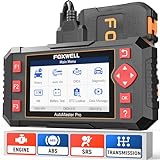
- [Easy to Use—Work Out of the Box] + [FOXWELL 2026 New Version] FOXWELL NT604 Elite scan tool is the 2026 new version from FOXWELL, designed for car owners who want to figure out the cause of issues before fixing car problems by scanning common systems like ABS, SRS, engine, and transmission. The NT604 Elite obd2 scanner diagnostic tool comes with the latest software—no need to waste time downloading software first. Plug the scanner into the OBDII port with OBDII cable to start the diagnosis.
- [Affordable] + [Reliable Car Health Monitor] Will you be confused what happens when the warning light of ABS/SRS/transmission/check engine flashes? Instead of taking your cars to dealership, this FOXWELL scanner will help you do a thorough scanning and detection for your cars and pinpoint the root cause. Note:The device is a diagnostic tool, not a repair tool. To turn off a warning light, you must first physically repair the issue causing it. Only then can the scanner be used to clear the corresponding fault code.
- [5 in 1 Car Diagnostic Scanner] Compared with obd scanners (50-100), NT604 Elite code scanner not only includes their OBDII diagnosis but also serves as ABS/SRS scanner, transmission and check engine code reader. When it’s an odb2 scanner, you can use it to check if your car is ready for annual test through I/M readiness menu. In addition, live data stream, built-in DTC library, data play back and print, all these features are a big plus for it. Note: doesn't support maintenance functions like reset or relearn. For the SRS system, NT604 Elite can read and clear common fault codes not caused by a crash, but crash/collision data cannot be cleared.
- [Fantastic AUTOVIN] + [No extra software fee] Through the AUTOVIN menu, this NT604 Elite car scanner allows you to get your V-IN and vehicle info rapidly, no need to take time to find your V-IN and input one by one. What's more, the NT604 Elite ABS SRS scanner supports 60+ car brands from worldwide (America/Asia/Europe). You don’t need to pay extra software fee. AUTOVIN may not work on some older vehicles or certain vehicle brands. If AUTOVIN fails, please input the vin code manually or go to the Diagnostic Menu to select your vehicle model.
- [Solid protective case KO plastic carrying bag] + [Lifetime update] Almost all same price-level car scanner diagnostic tool only offers plastic bag to hold the scanner.However, NT604 Elite automotive scanner is equipped with solid protective case, preventing your obd2 scanner from damage. Then you don’t need to pay extra money to buy a solid toolbox.
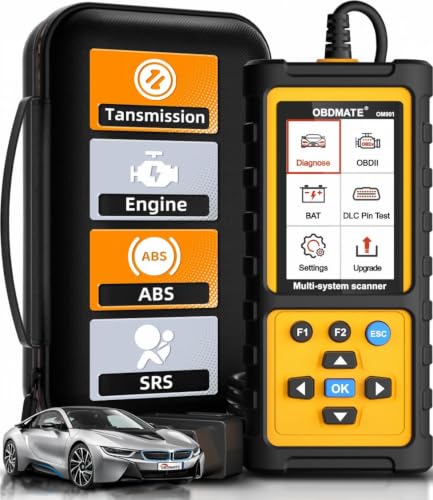
- 【Reset ABS/SRS/Transmission/Engine Lights】 More than an check engine code reader, OBDMATE OM901 obd2 scanner performs comprehensive diagnostics for the 4 most-used systems (ABS/SRS/Engine/Transmission). It quickly clears fault codes, turns off warning lights, read data stream and auto VIN.
- 【3.5" Handheld Scanner with 4 System Diagnose】 3.5" Super large TFT screen equipped displays an intuitive menu and clear readings of various sensors from ABS, SRS, ECM and TCM systems. It arrived with a silicone protective case and hard-shell carrying case, ensuring long-lived durability and drop resistance. The car diagnostic tool is plug-to-play designed, plug it and get diagnosis started without any batteries or updates required.
- 【One-Click I/M Readines&Full OBD2 Functions】 Press F1 to get an intuitive corloured form about whether various emissions-related systems on the vehicle are operating properly. Help you get smog-check ready quickly. OM901 car scanner supports all essential OBD2 functions you need: read & clear codes, view freeze frame, read I/M readiness, retrieve VIN, live data stream (with graphing display), O2 sensor test, onboard monitoring mode, and EVAP leak test.
- 【Battery Voltage Check&DLC Pin Test】 It allows you to monitor battery health by testing current battery voltage. Plus, this obd2 diagnostic tool features DLC 16-PIN test to check current voltage of every pin.
- 【Automotive Scanner Diagnostic Kit】 The package comes with 1 car scanner, 1 USB-type c cable, 1 hard storage bag and 1 user manual(en). Free to update without any hidden fees. 5 languanges available in setting including English, French, Italian, German and Espanish. Valuable and Portable, making it a great tool kit for car owners, DIY enthusiasts, and professional mechanics.
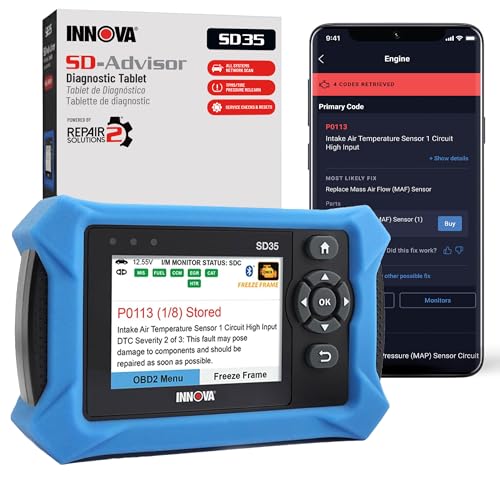
- OBD2 SCANNER FOR ALL SYSTEMS – The INNOVA SD35 is a tablet-based OBD2 scanner designed for advanced diagnostics. Read and clear check engine light, ABS, SRS, and TPMS codes, plus test your car battery and alternator to prevent unexpected failures. Vehicle coverage may vary. Please use Innova’s Coverage Checker to verify compatibility.
- ALL-SYSTEM DIAGNOSTICS & LIVE DATA – Unlike basic code readers, this OBD2 scanner for all vehicles scans engine, transmission, ABS, SRS, and more. Get real-time live data, including RPM, fuel trims, temperature readings, and oxygen sensor performance.
- OBD2 TABLET WITH USER-FRIENDLY INTERFACE – This automotive scan tool features a high-resolution display, making vehicle diagnostics faster and easier.
- ADVANCED TPMS, OIL RESET & SERVICE FUNCTIONS – Perform TPMS sensor checks, oil light reset, and other service resets with ease This professional diagnostic tool provides comprehensive vehicle maintenance capabilities in one device.
- WIDE VEHICLE COVERAGE (1996 & NEWER CARS & TRUCKS) – This OBD2 scanner Bluetooth tablet is compatible with Toyota, Ford, Honda, Chevrolet, Nissan, Dodge, and more. However, feature coverage may vary. Please use Innova's Coverage Checker to verify coverage.
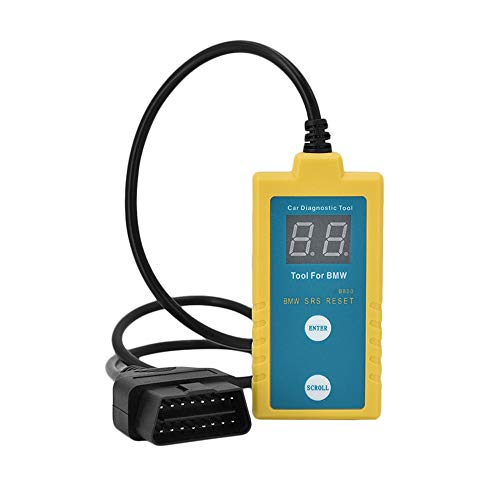
- ✔️【Professional SRS Reset for 1994-2003 BMW】 Designed specifically for classic BMW models (1994-2003). This B800 scanner reads & clears SRS airbag fault codes, turns off the warning light, and saves you a costly dealer visit. Confirmed compatible with: E36, E46 (EXCEPT 2001 330i), E34, E38, E39, Z3, and X5 (E53). NOT compatible with any BMW built before 1994 or after 2003.
- ✔️【Important: Two Different Connection Ports – Read Before Use】 To avoid “not working” issues, please note: For 1994–2000 BMWs (most E36, E34, Z3, early E39), the SRS diagnostic port is a round 20-pin connector under the hood. You MUST use the included 16-pin to 20-pin adapter cable. For 2000–2003 models (late E46, E39, X5), use the standard OBD-II port inside the cabin. Incorrect connection is the #1 reason for “incompatibility” reports.
- ✔️【Read & Clear Fault Codes in Minutes】 Quickly diagnose why your SRS light is on. The scanner accurately reads fault codes from airbag and seatbelt pretensioner systems. With one button press, clear the codes and reset the SRS warning light in seconds. No expensive dealer tools needed.
- ✔️【User-Friendly for DIYers – No Mechanic Required】 Easy operation with an intuitive button layout: ‘Enter’ to confirm, ‘Scroll’ to navigate. The clear LCD screen shows results instantly. Includes a step-by-step manual (revised for clarity) to guide you through the entire reset process.
- ✔️【Reliable Support with 1-Year Warranty】 We stand behind the quality of our B800 scanner. It comes with a 1-Year Hassle-Free Warranty. If you have any questions or need support, please contact us with your Order ID, and our dedicated team will assist you promptly.
- [All System Diagnostics, Professional-Level Scanner] - BLCKTEC 460T is the ultimate OBD2 diagnostic tool for home mechanics and professionals. It supports all 10 OBD2 modes, reads and clears Engine/Transmission/ABS/SRS codes, performs All-System Diagnostics, offers workshop reset tools, and provides real-time live data. It helps you pinpoint issues, assess your car's condition, and prepare for SMOG checks with ease. NOTE: Function availability depends on your vehicle. Before you buy, be sure to use the Compatibility Checker on BLCKTEC website or contact our customer support to verify that the features you need are supported for your vehicle’s specific year, make, and model.
- [12+ Most Popular Reset Functions] - BLCKTEC 460T OBD2 scanner offers 12+ dealer-level service functions, including Oil Maintenance Reset, ABS Bleeding, EPB Reset, SAS(Steering Angle Sensor) Recalibration, DPF(Diesel Particulate Filter) Reset, Throttle Body Relearn, Battery Reset/Initialization, TPMS Relearn, Transmission Reset, Fluid Change Reset, Maintenance Reset and more, enabling you to perform workshop services like a pro. NOTE: Function availability depends on your vehicle. Be sure to use the Compatibility Checker on BLCKTEC website to verify that the features you need are supported for your vehicle.
- [Real-Time OBD2 and OEM Live Data, Freeze Frame Data] - BLCKTEC 460T helps diagnose vehicle issues when warning lights like Check Engine Light or ABS/SRS Light appear. It offers detailed DTC info, ECU Freeze Frame Data, and real-time OBD2 and advanced OEM live data, including Engine, Transmission, ABS, SRS, and more, making it easy to diagnose and resolve vehicle problems. You can view, graph, record, replay, and overlay up to four live data streams in a single graph for better analysis.
- [AutoVIN, AutoReLink, AutoScan, 3X Faster] - Equipped with AutoVIN technology, 460T automatically retrieves the VIN to save you time. Its AutoScan and AutoReLink features scan all of the vehicle's ECUs and detect any fault codes immediately after you plug the scanner into the vehicle's OBD2 port - no button presses required. Additionally, it regathers DTC and I/M readiness information every 30 seconds, simplifying monitor tests. 460T's advanced technology makes it 3X faster than other products.
- [Get RepairSolutions2, the #1 Auto Repair App for Free] - When paired with RepairSolutions2(RS2) App, 460T becomes even more powerful. RS2's Verified Fix Database built by master technicians, provides the parts needed for the repair. Additionally, RS2 gives you access to OEM warranty info, maintenance schedules, TSB, and dealership recall info, making car care easier than ever. RS2 is free with no subscription fees and it stores your car scan reports in the cloud, allowing you to access, share, or print them anytime and anywhere.
This product presentation was made with AAWP plugin.